
Author
The GovLab at NYU Tandon announces the 100 Questions Initiative
Sourcing 100 questions on key societal challenges that can be answered by data insights
This article originally appeared at https://engineering.nyu.edu/news/govlab-nyu-tandon-announces-100-questions-initiative

BROOKLYN, New York, Wednesday, May 29, 2019 — The Governance Lab at the NYU Tandon School of Engineering announced the launch of the 100 Questions Initiative — an effort to identify the most important societal questions whose answers can be found in data and data science if the power of data collaboratives is harnessed.
The initiative, launched with initial support from Schmidt Futures, seeks to address challenges on numerous topics, including migration, climate change, poverty, and the future of work.
For each of these areas and more, the initiative will seek to identify questions that could help unlock the potential of data and data science with the broader goal of fostering positive social, environmental, and economic transformation. These questions will be sourced by leveraging “bilinguals” — practitioners across disciplines from all over the world who possess both domain knowledge and data science expertise.
The 100 Questions Initiative starts by identifying 10 key questions related to migration. These include questions related to the geographies of migration, migrant well-being, enforcement and security, and the vulnerabilities of displaced people. This inaugural effort involves partnerships with the International Organization for Migration (IOM) and the European Commission, both of which will provide subject-matter expertise and facilitation support within the framework of the Big Data for Migration Alliance (BD4M).
“While there have been tremendous efforts to gather and analyze data relevant to many of the world’s most pressing challenges, as a society, we have not taken the time to ensure we’re asking the right questions to unlock the true potential of data to help address these challenges,” said Stefaan Verhulst, co-founder and chief research and development officer of The GovLab. “Unlike other efforts focused on data supply or data science expertise, this project seeks to radically improve the set of questions that, if answered, could transform the way we solve 21st century problems.”
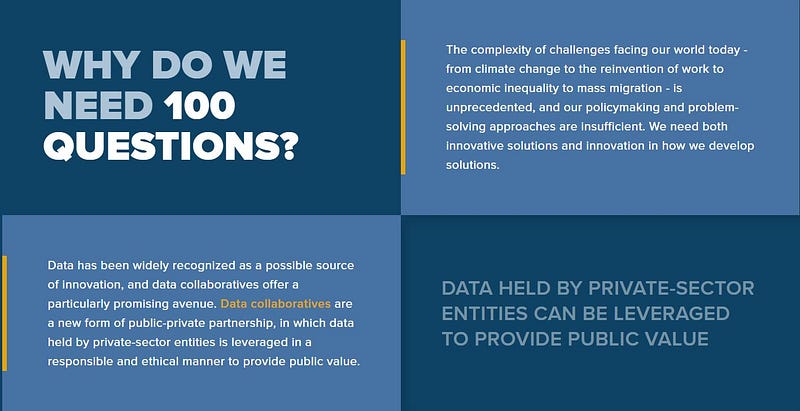
In addition to identifying key questions, the 100 Questions Initiative will also focus on creating new data collaboratives. Data collaboratives are an emerging form of public-private partnership that help unlock the public interest value of previously siloed data. The GovLab has conducted significant research in the value of data collaboration, identifying that inter-sectoral collaboration can both increase access to information (e.g., the vast stores of data held by private companies) as well as unleash the potential of that information to serve the public good.
“Organizations are far more likely to share data in response to a compelling use case,” said Tom Kalil, chief innovation officer of Schmidt Futures. “By identifying important questions that data science and machine learning can help us answer, we can spark collaborations between organizations that have critical data sets, teams that can derive insights from the data, and individuals and organizations that can make better decisions based on those insights.”
The 100 Questions Initiative is supported by a global advisory board comprising data science and subject matter experts from the public, corporate and non-profit sectors. Members include Ciro Cattuto, scientific director of ISI Foundation; Gabriella Gómez-Mont, founder and former director at Laboratorio Para La Ciudad; Molly Jackman, director of research at Chan Zuckerberg Initiative; Vivienne Ming, founder of Socos Labs; Wilfred Ndifon, director of research at AIMS Global Network; Denice Ross, fellow at Georgetown University’s Beeck Center for Social Impact and Innovation; and Matthew Salganik, professor of sociology at Princeton University.
Additional quotes from Global Advisory Board members and domain partners:
“Today, across companies, governments, and academia, there exists more data than ever before. Yet, data alone cannot solve problems — it is the insights that are derived from data that matter, and in order to get to insights we must start with clear questions and hypotheses. 100 Questions gets this right: by starting with questions, and then working backwards to identify appropriate data and methodologies, we’ll start to solve some of the world’s most pressing problems.” — Molly Jackman, director of research, Chan Zuckerberg Initiative
“Asking the right questions often makes the difference between finding light and staying in darkness. The 100 Questions Initiative will illuminate viable solution paths for some of the most pressing challenges of our time. Such solution paths tend to lie at the interface between disciplines, hence the importance of the Initiative’s emphasis on facilitating their discovery by communities of bilinguals.” — Wilfred Ndifon, director of research, AIMS Global Network
“Migration is one of the most pressing issues confronting policymakers around the world, and yet our understanding of the phenomenon is hampered by significant data gaps. This seems counterintuitive at a time when data have never been so abundant — and in fact, much more data exist than we can currently effectively and responsibly use to understand human mobility and inform sensible policy decisions. Data are no magic solution, but questions cannot be fully answered without reliable data and data are of little use without clear questions. This initiative will help us identify some of the key questions and spur collaborations across sectors and individuals to address them.” — Marzia Rango, research and data officer, IOM’s Data Analysis Centre (GMDAC)
“Most of the data in the world is collected by companies and governments, and most of that data is inaccessible to people who could make good use of it. Having a set of crisp, interesting, and important questions created by people who are both domain experts and data scientists is an important step in figuring out what is possible and moving us all to a world where we can responsibly learn from the data that is currently inaccessible.” — Matthew Salganik, professor of sociology, Princeton University
“Data science and innovation already demonstrated their value in providing new insights into some of today’s migration challenges. By defining the key questions that need to be answered, this initiative will harness such potential and could open the door to more unexplored datasets.” — Michele Vespe, European Commission Joint Research Centre
Throughout the lifespan of the 100 Questions Initiative, The GovLab and its partners will seek involvement from organizations that want to collaborate on specific domains, as well as people who possess both relevant domain knowledge and data science expertise. Anyone interested in collaborating is encouraged to send an email to contact@the100questions.org. For more information about the 100 Questions Initiative, visit www.the100questions.org, or contact Stefaan Verhulst, lead of the initiative at sverhulst@thegovlab.org.