
Author
The Auckland Council’s Emergency 2020/2021 Budget Consultation Makes Covid-19-era Inclusive Decision-Making A Reality
By Nandita Kohli
Introduction
This blog post is part of CrowdLaw’s Continuity of Legislatures series. The Continuity of Legislatures series is dedicated to looking into the innovative ways in which governments around the world have adopted online platforms for deliberation and voting in response to the challenges posed by Covid-19.
New Zealand’s Auckland Council established a set of six digital and remote methods of giving feedback for Auckland residents to raise their concerns and suggestions in the council’s budgetary decision making process as part of its response to the budgetary crisis. Below we will discuss these in further detail.
As the Covid-19 pandemic shuttered businesses and halted tourism around the world, The Auckland Council, which acts as the regional and municipal governing authority for Auckland, New Zealand, braced for budgetary damage. The Auckland Council estimated that the city will experience “a sizable drop in revenue next year” and projected operating cash income across the council to be “over $525 million [New Zealand dollars] less than previously budgeted.”
While 90% of feedback was received in a digital format, the demographic breakup of respondents matched closely with Auckland’s population demographics, even during the pandemic. This suggests that the council was able to reach a diverse subset of their constituents and therefore, be more inclusive in their decision-making process.
In order to better understand how the council was able to gather such a representative sample of Auckland’s population, this blog post examines the council’s general process for feedback and feedback analysis, their methods of outreach, the public’s response, and the final outcome made by the council.
Process/Workflow
This participatory decision making process is only the latest in a series of projects the city council has conducted on its Shape Auckland platform. Previous projects on this platform include the Piha Wetland Plan, the Proposal to amend the Revenue and Financing Policy, and the Review of council-controlled organisations (CCOs). However, none looks quite as complex nor extensive in feedback analysis as the Emergency Budget 2020/2021 consultation.
As of July 29, there are eight projects currently open to public feedback. The website is not only a participatory platform for policymaking. It is also a centralized way for the public to learn about decisions being made in the commercial and touristic hub of Auckland, NZ.
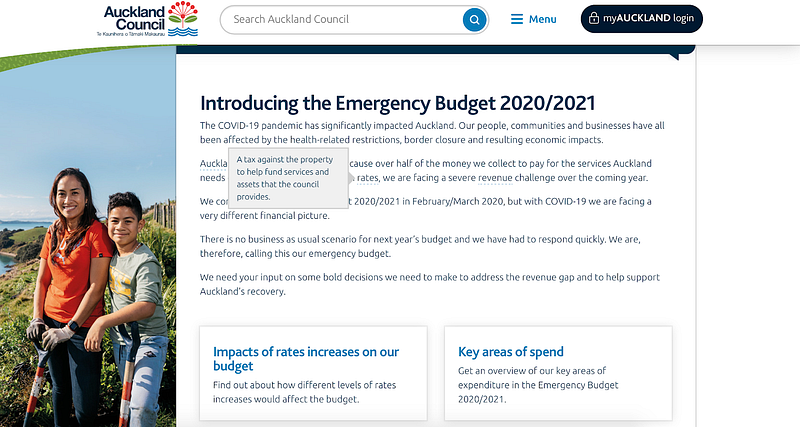
According to the council’s website, public feedback on the platform comes from a variety of sources including feedback forms, emails, letters, social media posts, and comments made at public meetings (usually in-person). Once feedback is collected, the council analyzes all feedback received and contextualizes it with advice from technical experts and other relevant evidence to make their final decisions for the community.
For each project requesting feedback from constituents, the Auckland Council is responsible for being transparent in who will make the final decisions, who will analyze the feedback and prepare the summary report, which other sources of information will be considered in the decision-making, and what the timelines are used for guiding reporting and decision-making.
According to Auckland’s Significance and Engagement Policy which was passed in December 2014, “The mayor has a responsibility to ensure there is effective community engagement” and local boards are additionally “responsible for communicating with local communities to help inform local decision making and communicate local views to the governing body on regional issues.”
The council uses (1) digital approaches such as email newsletters and social media, (2) the council’s website for consultations — Shape Auckland, (3) advertisements and articles in the media, (4) information and displays in libraries and service centers, (5) the council’s newsletter — OurAuckland, and (6) the People’s Panel — a survey-based mailing list, to keep the community of Auckland informed and engaged.
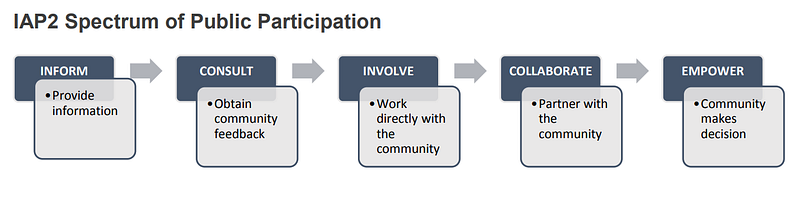
In order to achieve “effective community engagement” the council additionally follows the International Association of Public Participation (IAP2)’s five-step Spectrum of Public Participation approach outlined below.
Although the council is not bound to make decisions congruent with the majority of feedback, in abiding by the Local Government Act 2002, the council must identify people who will be affected by the decision, provide them with access to relevant information on the process and scope of the decision, encourage people to give their views, listen to and consider those views with an open mind, and after the decision, provide access to the decision and any other relevant material (Significance and Engagement Policy).
Methods of Outreach
In efforts to reach out to their constituents regarding budgetary plans for the upcoming year, the council held consultations open for the public’s feedback during the first two weeks of June. In addition, according to the feedback summary, the council claims to have contacted all ratepayers, previous submitters, library members, the People’s Panel, and stakeholders either via email or text.
The Council created six methods for constituents to voice their opinions, outlined below. The first three methods of communication involved constituents filling out a form (called the Annual Budget Feedback form) either online, by email or sent through post mail. Other methods of communication involved social media interactions, phone conversations, and attending community webinars.
The key decisions in the emergency budget were regarding property tax rates- the predominant source of income for the city. According to the feedback form, the questions put for public feedback were regarding (1) general (property tax) rates increase for 2020/2021, (2) rates postponement for ratepayers impacted by Covid-19, and (3) suspending the targeted rate paid by accommodation providers. The most controversial and impactful decision remained whether to go with the “planned 3.5% or a lower 2.5% average general rates increase” for the following year.
Public Response
Approximately 90% of all feedback was “received digitally” according to the feedback summary report. Each feedback method and its participation outcomes are outlined in more detail below. The feedback summary report analyzes a total of 34,915 pieces of feedback, out of which 24,297 responses came from the feedback form. 40% of respondents favored a 2.5% increase in rates while 37% favored a 3.5% increase.

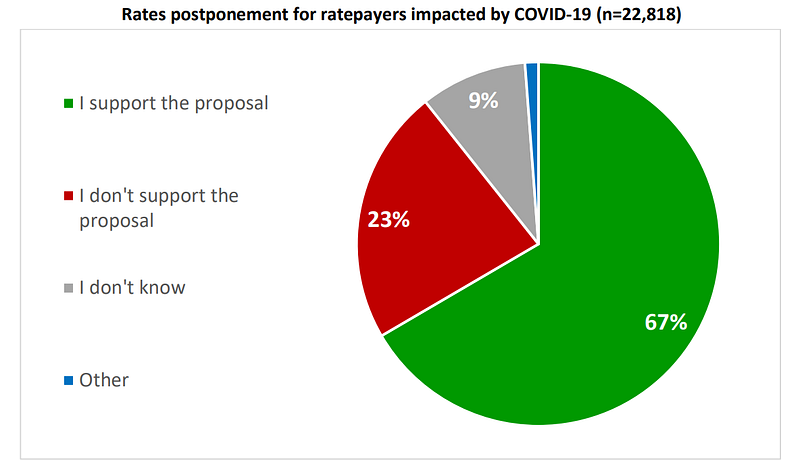
In response to the form’s second question on rate postponement for ratepayers impacted by Covid-19, 67% of responses supported this proposal, 23% did not support this proposal, and 10% selected the ‘I don’t know’ option or made a comment with no clear stance on the matter.
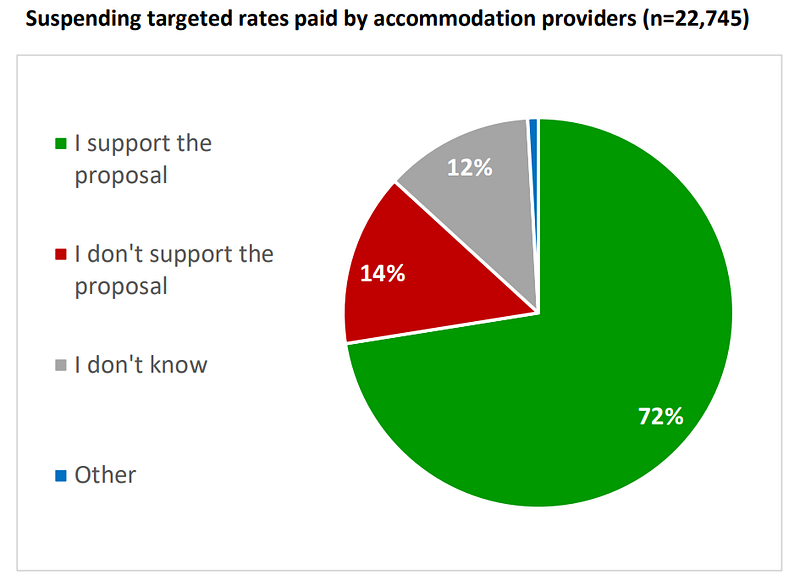
In the final question on the council’s proposal to suspend the Accommodation Provider Targeted Rate (APTR), which usually funds visitor attractions and major events that have been largely been halted due to Covid-19, 72% of responses supported the proposal, 14% did not support the proposal, and 13% selected ‘I don’t know’ or made an unbiased comment.
In addition to responding to the feedback form, residents also had the opportunity to get involved by commenting on social media platforms such as Twitter, Facebook, or Instagram using the hashtag #AKHaveYourSay. The council received 149 pieces of feedback through social media, which was taken into account within the feedback summary. The council also received 29 feedback responses via phone.
Finally, the feedback events, which were initially in-person (for the first two events) and later transitioned into seven Skype-based webinar events due to the severity of Covid-19, were recorded and uploaded as videos to YouTube where they received between 40–90 views each. The webinars can also be found in transcript form on the website.
Demographics
Of the 34,915 who responded to the survey, approximately 20,000 participants opted to respond to the demographics questions on gender, ethnicity, and age.
52% of respondents identified as female, 47% identified as male, and 1% identified as gender diverse. 76% claimed a European ethnicity, 8% claimed Maori, 14% Pacifika, 20% Asian, and 4% other. The largest age groups were 35–44 and 45–54, making up 9,541 respondents. The demographic breakup of the survey respondents matched closely with Auckland’s population demographics.
Outcomes/Impacts
In addition to these avenues of interaction, the Council recorded all feedback, including feedback from external organizations (referred to as pro forma responses), in their feedback submissions link.
Feedback analysis and political deliberations between council members occurred June 20 through July 15. The budgetary decisions were to be finalized on July 16 and would be step five of seven in the final adoption of the new annual budget.
After much deliberation, the council decided to increase the rates by 3.5% for the following year. Mayor Phil Goff delivered Auckland Council’s emergency budget decision, stating that many cuts would have to be made. In a final attempt to save jobs and basic services, the council chose a 3.5% rate increase.
The council has also decided to allow ratepayers in short-term financial difficulty to postpone “a maximum of $20,000 in rates per property over the next 12 months, with a forecast take-up totalling $50 million”.
This blog post is the first in a two-part series on the Auckland Council’s Emergency 2020/2021 Budget Consultation. The second part will cover in more depth how the feedback sample was conducted in order to achieve these representative outcomes and how the feedback was used in the decision-making process of council members.
This post is part of a series on the Continuity of Legislatures. Find the whole series here.
