
Author
France: President Macron’s party engages in discussions about participatory democracy and collective intelligence
By Nicola Forster and Ivo Scherrer
Authors:
- Nicola Forster, Co-Founder of the think tank foraus & Swiss public innovation lab staatslabor, @nicolaforster
- Ivo Scherrer, Economist and Co-Founder of Participatory Think Tank Argo, @ivoscherrer
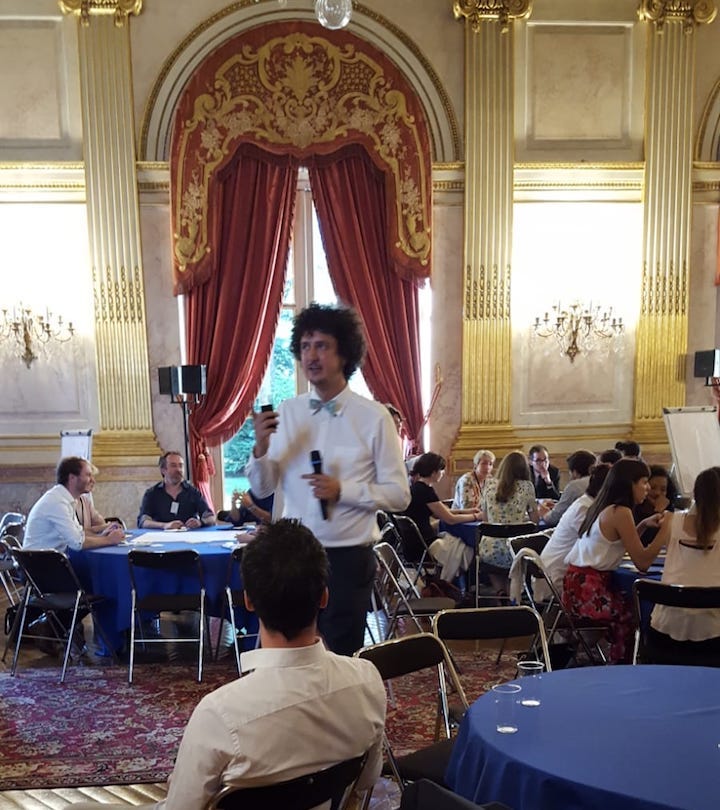
On July 4th, the recently founded Political Innovation Lab of “La République en Marche” hosted a first colloque d’innovation politique at the French National Assembly. Moderated by Stephen Boucher, author of the “Petit manuel de créativité politique”, the event featured academics Prof. Hèlène Landemore (Yale University) and Prof. Lex Paulson (Sciences Po) as well as crowdsourcing practicioners from the participative think tanks Argo and foraus. In the audience, MPs and administration officials mingled with civic tech pioneers and social entrepreneurs to discuss the use of collective intelligence in law making.
Mounir Mahjoubi, Secretary of State for Digital Affairs, opened the event with a pladoyer for more participative politics and invited the newly elected members of parliament to engage in a meaningful dialogue with citizens.
In her keynote address, Yale professor Hélène Landemore (author of “Democratic Reason: Politics, Collective Intelligence, and the Rule of the Many”) showed that engaging in inclusive deliberation can help lawmakers o benefit from the distributed intelligence and the cognitive diversity of citizens.
Sciences Po Professor Lex Paulson cited examples from around the globe (Brasil, Ireland, Iceland or Switzerland) to show how other parliaments already engage in Crowdlaw. After this, several French MPs pitched their projects on how to engage citizens and use civic tech in law making. One of them, MP Paula Forteza, who represents the Second constituency for French residents overseas (Latin America and the Caribbean) is one of the civic tech frontrunners in the French parliament and has organised a Datafin Hackathon for participatory budgeting.
The second part of the event made use of the collective intelligence gathered in the room. Nicola Forster, founding president of the grassroots think tank foraus and Ivo Scherrer, co-founder of the participatory think tank Argo, called attendees of the event to answer the following challenge : “How to better integrate French citizens in public policy with the help of civitech?” Attendees had to develop their solutions, collaborating in the framework of an Open Situation Room, a design thinking process of ideation, discussion and selection of ideas, designed to harness the collective wisdom of everyone for pressing questions of public policy.
The Open Situation Room provided a practical example of how citizens’ voices can be part of lawmaking thus linking to the examples and reflections made by Prof. Landemore and Paulson in the first part of the event. While there are many options to improve democratic participation, one conclusion was shared: there’s a lot of work to be done if policy makers want to be serious about more democratic participation.