Data Collaborative Case Study: Global Fishing Watch
Pooling Data and Expertise to Combat Illegal Fishing
By Michelle Winowatan, Andrew Young, and Stefaan Verhulst
This is the second installment of an ongoing series of case studies on Data Collaboratives and Data Stewardship. These case studies intend to provide insights toward leveraging private data for public good in a systematic, sustainable and responsible manner.Subscribeto our Data Stewards Newsletter to be notified of future releases.
Summary: Global Fishing Watch, originally set up through a collaboration between Oceana, SkyTruth and Google, is an independent nonprofit organization dedicated to advancing responsible stewardship of our oceans through increased transparency in fishing activity and scientific research. Using big data processing and machine learning, Global Fishing Watch visualizes, tracks, and shares data about global fishing activity in near-real time and for free via their public map. To date, the platform tracks approximately 65,000 commercial fishing vessels globally. These insights have been used in a number of academic publications, ocean advocacy efforts, and law enforcement activities.
Data Collaborative Model: Based on the typology of data collaborative practice areas, Global Fishing Watch is an example of the data pooling model of data collaboration, specifically a public data pool. Public data pools co-mingle data assets from multiple data holders — including governments and companies — and make those shared assets available on the web. This approach enabled the data stewards and stakeholders involved in Global Fishing Watch to bring together multiple data streams from both public- and private-sector entities in a single location. This single point of access provides the public and relevant authorities with user-friendly access to actionable, previously fragmented data that can drive efforts to address compliance in fisheries and illegal fishing around the world.
Data Stewardship Approach: Global Fishing Watch also provides a clear illustration of the importance of data stewards. For instance, representatives from Google Earth Outreach, one of the data holders, played an important stewardship role in seeking to connect and coordinate with SkyTruth and Oceana, two important nonprofit environmental actors who were working separately prior to this initiative. The brokering of this partnership helped to bring relevant data assets from the public and private sectors to bear in support of institutional efforts to address the stubborn challenge of illegal fishing.
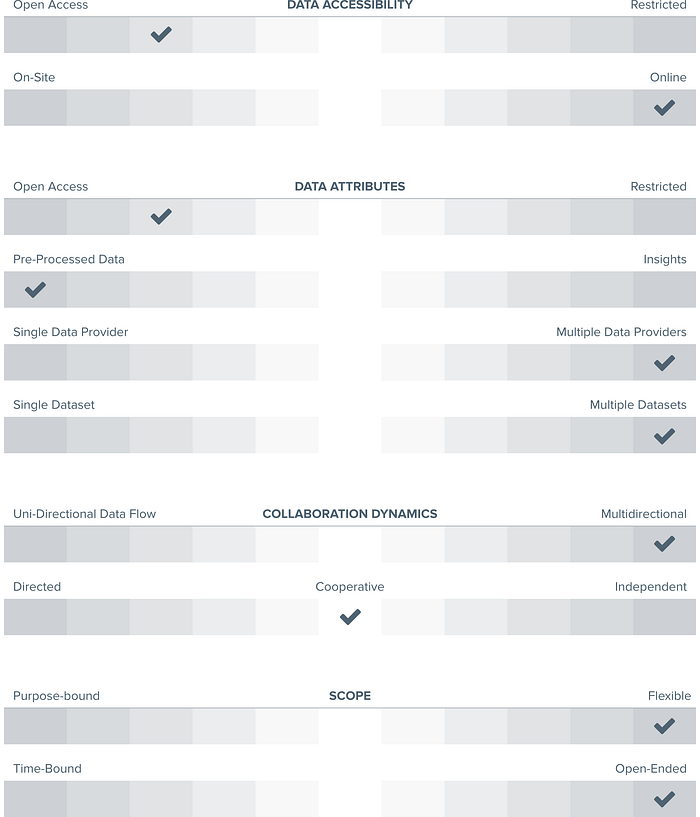
Global Fishing Watch Data Collaborative Operational Variables. Detailed description of each variable can be found here.
Michelle Winowatan is a Research Assistant at The GovLab, where she focuses on exploring the ways data and collaboration can improve policymaking. Previously, she has worked at several international nonprofit organizations, such as Search for Common Ground and Human Rights Watch, implementing projects that focused on conflict and human rights issues. She is a Fulbright awardee, through which she obtained her MPA in Public and Nonprofit Management and Policy from New York University. She also has a BA in International Relations from Universitas Pelita Harapan, in Indonesia.